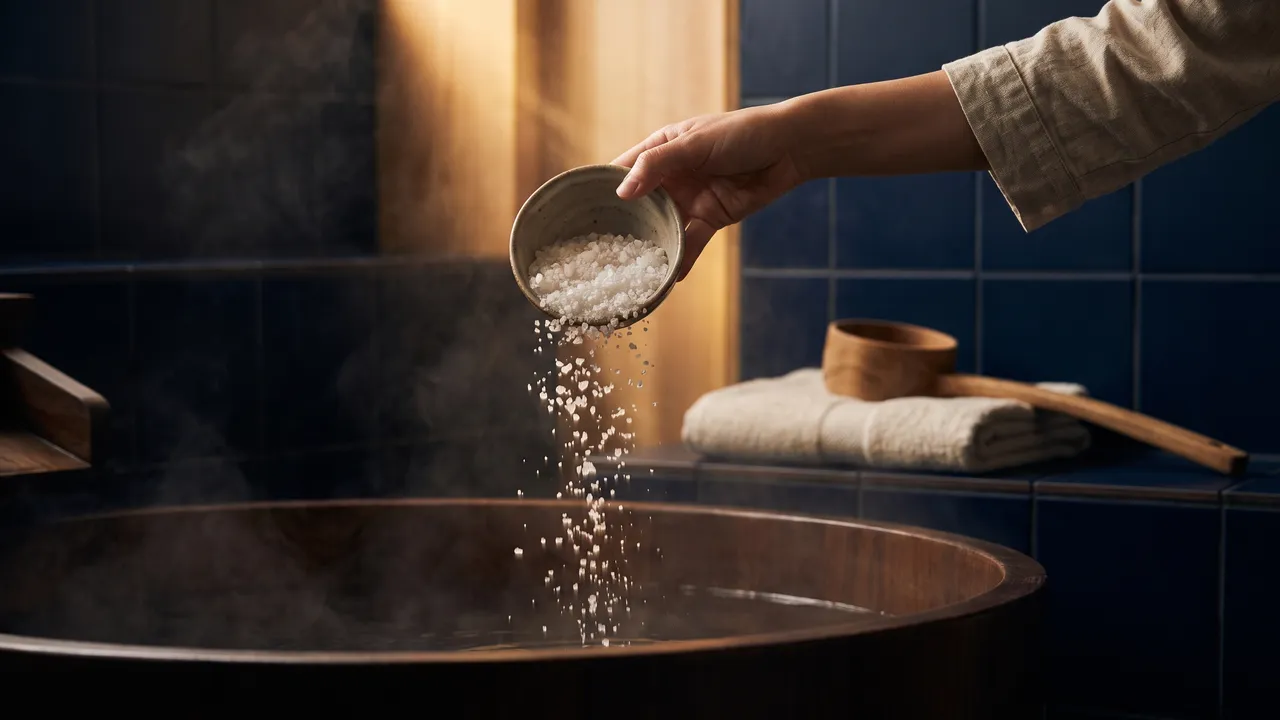
The short answer is two to three times a week. That is the frequency the bathing research tends to use, it is enough to build a habit, and it suits most skin without pushing it.
But frequency is really a question about what you are trying to get out of the bath, and the honest answer changes depending on which of those you are after.
By What You Are After
For Sleep: three to four times a week, or nightly
The sleep effect of a warm bath comes from the temperature drop afterwards, and there's no sign it wears off if you bathe often. If a bath ninety minutes before bed is going to be your wind-down routine, nightly is fine. Use a lighter hand with the salts if you go daily, and keep the water at 38 to 40 degrees. The timing detail matters more than the frequency here.
For Muscle Recovery: after hard sessions
Match the bath to the training rather than the calendar. Two or three genuinely hard sessions a week means two or three recovery soaks. There is no benefit in soaking on a rest day when nothing is sore, beyond the fact that it is pleasant, which is a perfectly good reason on its own.
For Dry Skin: two to three times a week, not daily
This is the one case where more is genuinely worse. Even a well-run bath involves twenty minutes of water working against your skin barrier, and dry or sensitive skin needs recovery days in between. Our guide to bath salts for dry skin covers how to make each one count.
For Winding Down: whenever you like
If your skin is happy, there's no reason to ration a relaxing bath. The trial that found people felt less stressed with regular bathing used a short soak every day for two weeks, not the occasional marathon session, so little and often is the way to go.
Much of Japan bathes daily and has for centuries, which is a fairly compelling long-term trial. The details matter, though: the Japanese wash thoroughly outside the tub and enter it clean, so the soak itself involves no soap or detergent at all. That is the version that is sustainable daily. A daily bubble bath is not the same practice.
How Much to Use Each Time
Under-dosing is a more common mistake than over-dosing, and it is the reason a lot of people conclude that bath salts do nothing. A tablespoon in 150 litres of water is a rounding error.
A generous half cup, roughly two scoops, in a standard Australian tub is the concentration where a mineral bath starts behaving like a mineral bath. Dissolve it while the tub is filling, under running water, rather than tipping it into a still bath and sitting on undissolved crystals. If you only have a shower, our guide on how to use bath salts covers foot soaks and scrubs.
Signs You Are Overdoing It
- Tight, squeaky or itchy skin afterwards. Either too frequent, too hot, or too concentrated. Pull one of those levers back.
- Light-headedness on standing. The water is too hot or the soak too long. Both are easy to fix.
- Sleeping worse, not better. Usually a bath too close to bedtime or water above 42 degrees, which raises heart rate rather than lowering it.
- Dreading it. The moment a ritual becomes an obligation it has stopped delivering the thing you wanted from it.
"Two good baths a week will do more for you than seven rushed ones. This is a practice, not a streak to maintain."
What That Costs
Worth doing the arithmetic before you commit to a routine, because frequency is what determines whether a habit is affordable.
A 1kg pouch of Miyomi gives 8 to 10 proper soaks at a generous half cup each. At $35 that is about $4 a bath. Twice a week works out to roughly a pouch a month; three times a week is closer to a pouch every three weeks. Set against a single massage or a spa visit, a month of restorative baths at home is not an extravagance, and our pricing page has the one, two and three pouch sets.
Building the Habit
The reason most bath rituals fail is not cost or time. It is that they have no fixed place in the week. Anchor it to something that already happens: Sunday evening before the week starts, the night after your hardest training session, the evening you always sleep badly. A ritual attached to an existing rhythm survives. One that depends on remembering to want it does not.
Twenty minutes, twice a week. That is the whole prescription. Join the list and the first 100 get a founder code for $10 off the first order.