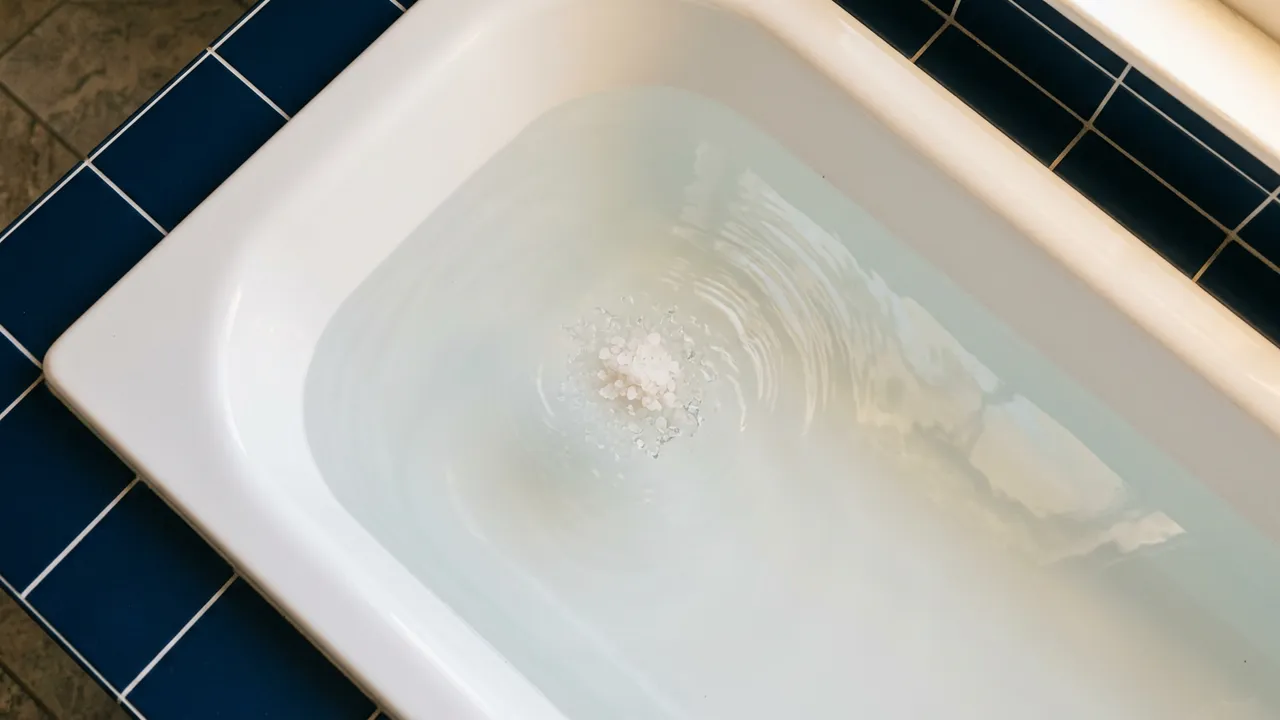
Short answer: no. A bath does not pull toxins out through your skin, whatever you put in the water. That is an odd thing for a bath salt company to put in writing, but it is true, and we would rather you believed the rest of what we tell you.
A salt bath does plenty that is worth doing. Removing toxins isn't on the list. Here is where the idea comes from, what happened when researchers actually tested it, and what a salt bath is genuinely good for.
Where the Idea Comes From
Search for a detox bath and you will find the same recipe again and again: a cup or two of Epsom salt, some bicarb soda, and perhaps apple cider vinegar, ginger or a few drops of essential oil. The explanation is usually one of two things. Either the minerals soak in and push something out, or the salty water "draws out" toxins by osmosis.
Both sound plausible because both borrow real words. Neither survives three simple questions: which toxin, how much of it, and how did anyone measure it?
What Osmosis Actually Does
Osmosis is water moving across a membrane, from the less salty side to the saltier side. It moves water, not toxins. And the outer layer of your skin is not a loose membrane waiting to be flushed. It is a tightly packed barrier whose whole job is to keep water in and everything else out.
That barrier is the reason you can spend an afternoon in the ocean without shrivelling like a salted cucumber, and the reason the bath doesn't end up inside you. It works in both directions. Whatever your body is carrying stays where it is until your liver and kidneys deal with it.
The Test Someone Actually Ran
The most famous detox bath is the ionic foot bath, where the water turns brown or orange while your feet are in it and the colour is presented as whatever came out of you. In 2012, researchers in Toronto put one to a proper test. They ran the device with feet in the water and without, and measured what ended up in the water, in the participants' urine and in their hair.
The metals in the water rose whether or not anyone's feet were in it. The ones that rose most, including iron, chromium, nickel and manganese, closely matched the stainless steel of the device's own electrodes, which corrode faster in salty water with a current running through it. Urine and hair showed no meaningful change. The authors found no evidence that the foot bath helped the body get rid of anything.
"If the water turns the same colour with nobody's feet in it, the colour is not coming from anybody's feet."
What About Sweating It Out?
A hot bath makes you sweat, and sweat often gets the credit for detoxing. Sweat is mostly water and salt. In 2018, researchers at the University of Ottawa and McGill worked out how much of the persistent pollutants people worry about could leave the body this way. Their estimate: an extra litre of sweat a day would carry out less than 0.024 percent of the PCBs a person takes in from food over the same day. In their words, it is negligible.
Your Body Already Has a Detox System
Your liver breaks down what needs breaking down, and your kidneys filter it out. Your lungs and gut handle some of the rest. When those organs are working, they don't need help from the bathroom. When they aren't, that is a matter for a doctor, and no amount of Epsom salt changes it.
It is also why "detox" on a bath product tells you about the marketing rather than the product. The word has no agreed meaning, and there is nothing a shopper can check it against.
And the Magnesium?
This is a separate claim, and a fairer one to ask about. The idea is that magnesium from Epsom salt soaks in through the skin. The evidence usually quoted is a 2004 report from the University of Birmingham in which 19 people took Epsom salt baths and showed small rises in blood magnesium. It was never published in a peer-reviewed journal, it had no control group, and nobody has repeated it.
A 2017 review in Nutrients went through the evidence and concluded that absorbing magnesium through the skin is not scientifically supported. Our guide to magnesium bath soaks covers the detail. And even if some magnesium did get in, that would be something going into you, which is the opposite of a detox.
The Other Detox Ingredients
Most detox recipes are harmless in a full bath. A few details are still worth knowing.
- Essential oils. Oil and water don't mix, so drops of neat oil float on the surface and land on your skin undiluted. Stir them into the salt, or into a spoonful of carrier oil, before they go in.
- Apple cider vinegar. It is an acid. Well diluted in a full bath it is mostly a smell, but it can sting on freshly shaved or broken skin.
- Ginger and mustard. Both are sold as warming. The tingle they give is mild skin irritation, which some people enjoy and people with sensitive skin generally don't.
When a bath product promises to remove toxins, ask which toxins, how much, and measured how. If the answer is vague, the claim is marketing. A product that tells you what it is made of and how it feels is being more straight with you than one that tells you what it takes away.
What a Salt Bath Does Do
Take away the detox story and a salt bath is still worth running. It is twenty minutes of warm water with the door shut, which most people don't otherwise get in a day. Dissolved salts give the water a softer, silkier feel than plain tap water, and a good scent turns washing into something you look forward to. You come out clean, warm and, if you moisturise straight after, with soft skin.
That is the honest version, and it is enough. If you want more out of it, our guides to the right bath temperature and how to use bath salts cover the details that make the difference.
Using Miyomi
We will never call Miyomi a detox, because it isn't one. It is Epsom salt with bicarb soda, green tea extract and steam-distilled yuzu peel oil, made to make a warm bath smell good and feel good. That is the whole claim.
We have not opened yet. The first batch is being blended now, and the first 100 on the waitlist get a founder code for $10 off. Join the waitlist.
Sources
- Journal of Environmental and Public Health (2012): Objective assessment of an ionic footbath (IonCleanse)
- Environment International (2018): Can POPs be substantially popped out through sweat?
- Nutrients (2017): Myth or reality, transdermal magnesium?
- Waring, University of Birmingham (2004): Report on absorption of magnesium sulfate across the skin (unpublished)