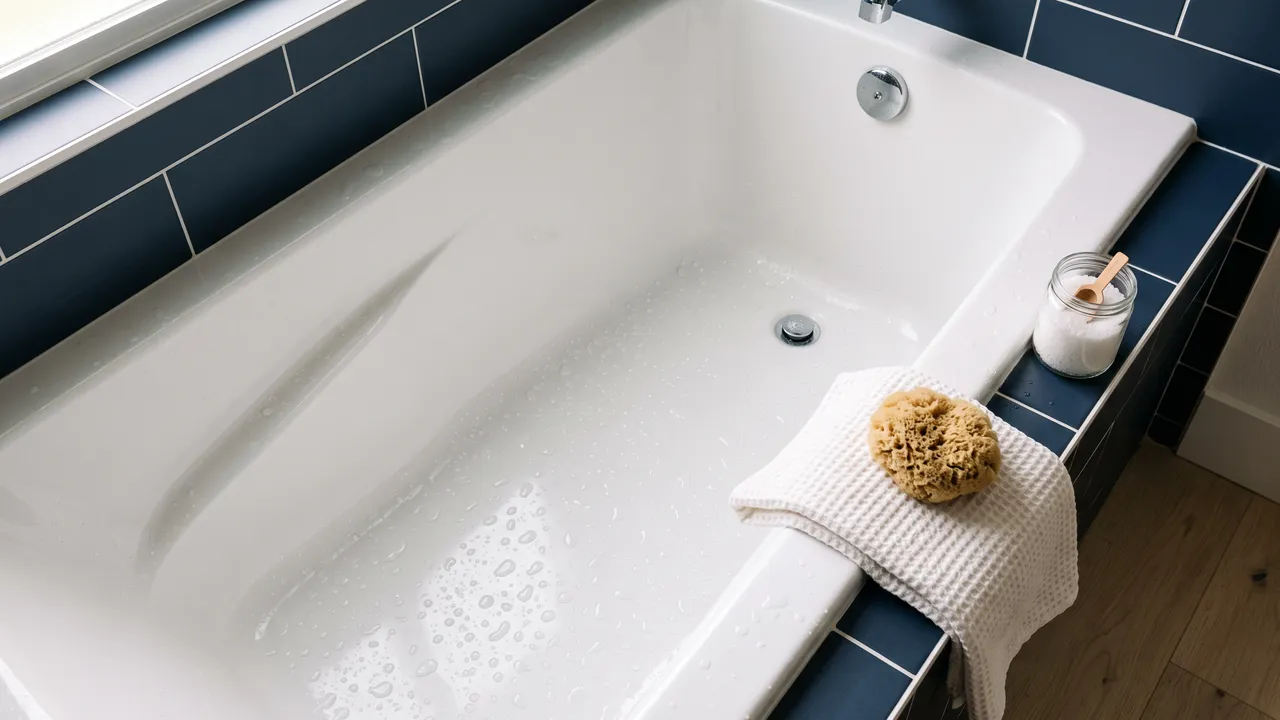
Plain bath salt doesn't stain. Epsom salt, sea salt and magnesium flakes all dissolve completely in warm water and drain away with it. When a tub ends up with a ring, a film or a tint after a soak, the cause is almost always something else in the jar, or in the water.
What Actually Leaves a Mark
- Oils. Bath oils, carrier oils and essential oils float on the surface and settle at the waterline as the bath drains. Mixed with body oils and soap, that's the ring.
- Dyes and glitter. Coloured bath salts and bath bombs use colourants that can tint grout, older baths and scratched surfaces, especially if they land on a dry tub before the water goes in.
- Plant extracts. Tea, dried botanicals and spices carry natural pigments. Green tea is a good example: its catechins slowly turn yellow-brown as they react with air, the same reason a cup of tea stains a mug.
- Undissolved salt. Coarse salt tipped into a near-empty tub can sit on the base and dry into a white crust. It isn't a stain, but it looks like one.
- Hard water. The minerals in hard water react with soap to form soap scum and dry into white spots. Bath salts get blamed for a lot of this.
If you want to compare the salts themselves, our guide to Epsom salt, Dead Sea salt and magnesium flakes covers how each one dissolves.
Caring for an Acrylic Bath
Many modern baths in Australia are acrylic: light, warm to the touch, and softer than enamel. Caroma's care guide for its freestanding baths is a good model for any acrylic tub.
- After each bath, wipe it with a soft cloth and warm soapy water. That removes the body oils and soap residue that build up into a ring at the waterline.
- Skip abrasive powders, pastes and creams, and scourers. They scratch the surface, and a scratched surface picks up marks far more easily.
- If you use coloured oils, test first that the colour won't mark your bath.
- Add oils to a bath that's already full of water, never to an empty tub.
Caring for an Enamelled Steel Bath
Enamel is harder than acrylic, but the glaze can still dull. Kaldewei, which makes steel enamel baths, gives similar advice.
- Rinse and wipe after use. A mild detergent is enough for everyday cleaning.
- Avoid coarse abrasive cleaners, strong acid or alkaline cleaners such as concentrated vinegar, steel wool and scouring pads.
- Dry dark coloured baths after use to stop calcium building up.
- For limescale, use a lukewarm mix of one part vinegar to one part water, never neat vinegar.
"Salt rinses away. The ring is oil and soap at the waterline, and thirty seconds with a soft cloth stops it building up."
A Two-Minute Routine After Every Soak
- Dissolve first. Pour salts under the running tap, not into a near-empty tub, so nothing sits on the base.
- Rinse as it drains. Run the hand shower around the waterline while the water goes down.
- Wipe the line. A soft cloth or sponge with a drop of dishwashing liquid.
- Rinse and dry. One more rinse with warm water, and a towel over dark or matt finishes.
- Store salts sealed. Damp salt sets into lumps that don't dissolve evenly next time.
A Note on Spa Baths
Spa and jet baths are a different case. Oils, plant extracts and undissolved grains can build up inside the pipes and jets, where you can't wipe them. Unless the product says it is suitable for spas, keep it to an ordinary bath, and follow the spa maker's instructions for flushing the system.
Where Miyomi Fits
Miyomi is Epsom salt and bicarb soda with green tea extract and steam-distilled yuzu peel oil, made to dissolve under the running tap. Whatever you soak in, the two-minute routine above is the habit worth keeping.
We have not opened yet. The first 100 on the waitlist get a founder code for $10 off. Join the waitlist.