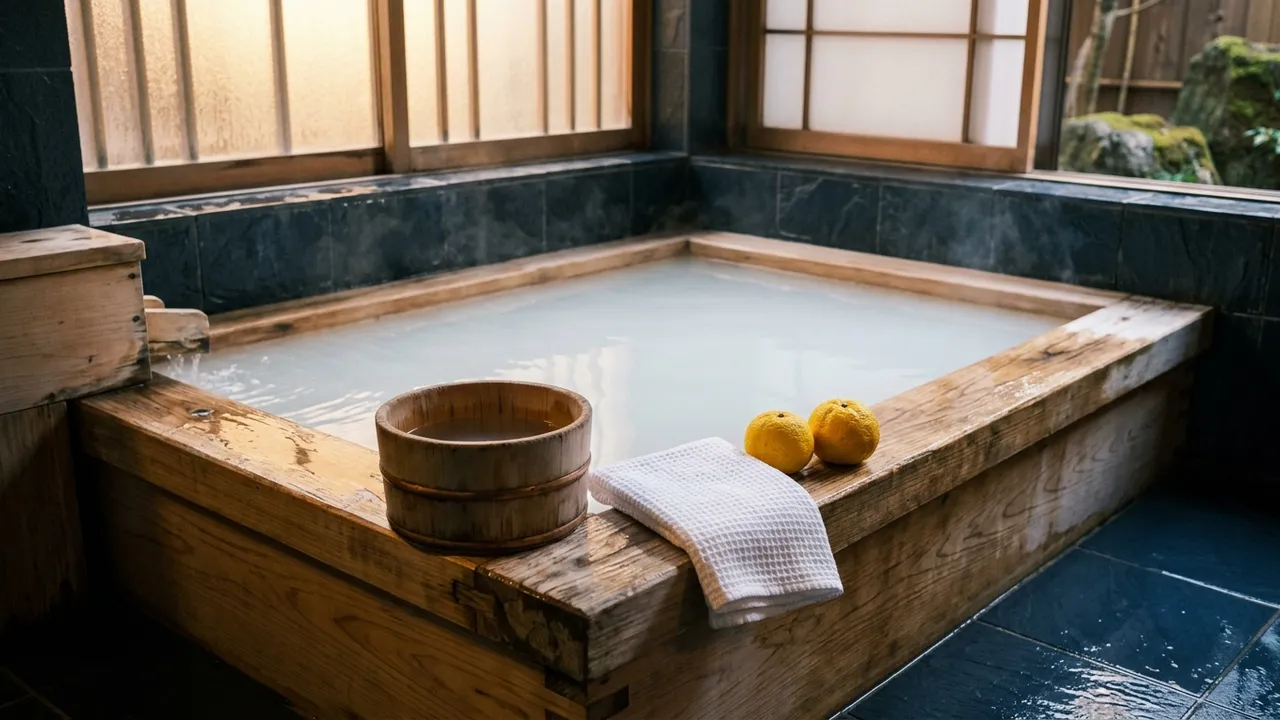
In Japan, bath salts are not a gift-shop item. They sit in the supermarket and the pharmacy near the toothpaste, sold in multipacks and in dozens of scents and colours. The category is big enough to have its own industry association. The Japanese word is nyūyokuzai (入浴剤), which translates plainly as "bathing agent".
To see why they are so ordinary there, and so different from most bath salts sold here, it helps to start with the Japanese bath itself.
A Bath Built for Soaking, Not Washing
A Japanese bath happens in a set order. You wash and rinse outside the tub first, sitting on a small stool with a hand shower or a bucket. Only once you are clean do you get in, and the tub is purely for soaking. Because nobody washes in it, a household traditionally shares the same bathwater, one person after another, with a lid keeping it hot between turns. Around 70 percent of people in Japan take a bath every day in winter, and most set the water between 40 and 42 degrees.
That changes what a bath product is for. There is no soap to compete with and no need for foam. A bath additive in Japan is there to change the water itself: its colour, its scent and how it feels on the skin. It is closer to making tea than to making bubbles.
Where Nyūyokuzai Came From
Bathing with plants is old in Japan. Yuzu is floated in the bath on the winter solstice, a custom we cover in our yuzu guide, and iris leaves go into the bath in early May for Children's Day. Hot spring towns sold yu-no-hana, the mineral deposits collected from their springs, so visitors could take a little of the onsen home.
The first bath additive sold as a packaged product arrived in 1897, from Tsumura Juntendo, the company now known as Tsumura. It made a herbal remedy for women called Chūjōtō, and the story goes that an employee took the leftover herbs home and put them in their child's bath. The company turned the idea into a product and sold it to public bathhouses. In 1930 it followed with Bathclin, a fragranced additive whose bright green water became familiar to generations of Japanese families.
Two later changes shaped the aisle as it looks today. From the mid-1950s, new apartment blocks brought private bathrooms into ordinary Japanese homes, and bathing moved from the public bathhouse into the flat. Bath additives followed. Then in 1983, Kao launched Bub, a tablet that fizzes out carbon dioxide as it dissolves, and created a category of its own. By the mid-1980s, companies were recreating the look of famous hot springs, including the milky white water of Noboribetsu in Hokkaido.
The Main Types
Japan's bath additive industry sorts its products by what is in them. Most packets on the shelf today combine more than one type.
- Mineral salt types. The base of most blends: salts such as sodium sulfate and sodium bicarbonate, which change how the water feels. Epsom salt belongs to the same family.
- Carbonated types. Tablets or granules that pair a carbonate with an organic acid, so they fizz and release carbon dioxide as they dissolve. The same chemistry as a bath bomb, without the glitter.
- Herbal types. Built on dried plants and traditional herbal ingredients, the direct descendants of that first product in 1897.
- Skincare types. Usually milky, with added oils or moisturising ingredients, and often made to look like the cloudy water of a hot spring.
- Cooling types. Summer formulas with menthol, for a bath that feels fresh rather than warming on a humid night.
A smaller group is built on enzymes. They come as powders, granules, tablets and liquids, usually one sachet or tablet to a bath.
"In Japan the tub is for soaking, not washing. A bath additive is there to change the water, not to clean you."
What the Packets Say, and Why Ours Don't
Buy a Japanese bath additive and you will notice the packet makes more specific promises than Australian bath products do. That is regulation, not modesty. Many bath additives sold in Japan are approved as quasi-drugs, a Japanese category that sits between cosmetics and medicines and allows approved wording about what the product does.
Australia has no equivalent. Here, a bath product is either a cosmetic, which can talk about scent, feel and how skin looks, or a therapeutic good, which has to be listed with the TGA before it can make health claims. That is why Australian bath salts, ours included, talk about how a bath smells and feels. When you buy an imported Japanese product, the claims on the pack were approved for Japan, not here.
How to Use Them the Japanese Way
- Wash first. Shower before you get in, so the bath is only for soaking. It also keeps the water clean enough to share.
- Fill to 40 degrees or just under. The Japanese habit is 40 to 42, but Japan's own safety advice caps it at 41. Our guide to bath temperature explains why.
- Add it at the right moment. Tablets go in just before you get in, so you catch the fizz. Powders and salts go in under the running tap.
- Soak, don't scrub. Ten to fifteen minutes, sitting still, no soap in the tub.
- Rest after. A glass of water and a few quiet minutes before the next thing. Our onsen at home guide covers the whole ritual.
One caution: milky and oily types can leave residue in the pipes and jets of a spa bath. Unless the packet says it is suitable, keep them to an ordinary tub.
Where Miyomi Fits
To be clear, Miyomi is not a Japanese product. It is made in Australia, and it borrows the Japanese idea of the bath rather than copying a Japanese packet. The base is Epsom salt, with bicarb soda to soften the water, plus green tea extract and steam-distilled yuzu peel oil, two plants with a long history in the Japanese bath. No dyes, no fizz, no quasi-drug promises. Just a bath that smells of yuzu, and a reason to take twenty minutes.
We have not opened yet. The first 100 on the waitlist get a founder code for $10 off. Join the waitlist.